This entry introduces the “Single System” framing: the idea that a house is not a pile of gadgets or independent subsystems, but one continuous, comprehensible whole. The purpose is legibility over decades, not features.
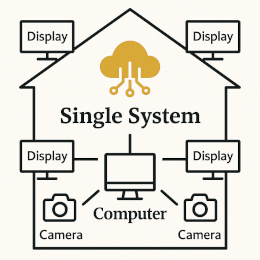
In practice, “single system” means the interfaces, the logging, the safety constraints, and the failure modes are treated as first-class. Automation does not act on single sensors or single events; it acts on accumulated evidence.
Over time, the system should become calmer: fewer surprises, fewer unknowns, fewer untracked dependencies. The house becomes easier to understand, not harder.
Draft note: Replace this section with your own articulation of the thesis, and keep the rest of the page structure unchanged so the site stays uniform.